Just one week after his high-profile short call on Kodiak Sciences ($KOD) was completely dismantled by the Phase 3 DAYBREAK readout, former hedge fund manager and pharmaceutical executive Martin Shkreli has re-emerged on social media with another provocative call.
This time, Shkreli is playing offense as an aggressive bull on Liquidia Corporation ($LQDA):
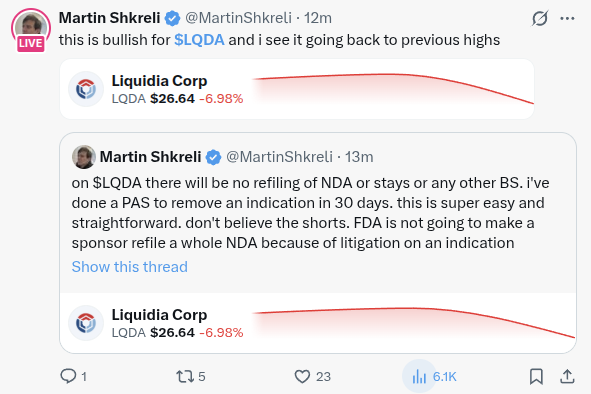
“this is bullish for $LQDA and i see it going back to previous highs”
Quoting / Replying to his own post:
“on $LQDA there will be no refiling of NDA or stays or any other BS. i’ve done a PAS to remove an indication in 30 days. this is super easy and straightforward. don’t believe the shorts. FDA is not going to make a sponsor refile a whole NDA because of litigation on an indication”
— Martin Shkreli (@MartinShkreli), October 5, 2026
The backdrop to Shkreli’s call is sheer market carnage. On September 30, 2026, Judge Richard G. Andrews of the U.S. District Court for the District of Delaware ruled that Liquidia’s commercial dry-powder treprostinil drug, YUTREPIA®, infringes claims 1 and 14 of United Therapeutics’ ($UTHR) U.S. Patent No. 11,826,327 (the ’327 patent).
Shares of Liquidia collapsed by over 57% in a single session—plummeting from $70.69 to $30.26—and continued drifting lower to $26.64 (-6.98% intraday), wiping out more than $3.8 billion in market capitalization.
Short sellers immediately declared YUTREPIA finished, claiming that under 35 U.S.C. § 271(e)(4)(A), the federal court would force the FDA to revoke YUTREPIA’s New Drug Application (NDA) approval entirely, trigger a new 30-month Hatch-Waxman stay, and pull the product off pharmacy shelves.
Shkreli claims the shorts are fundamentally ignorant of FDA procedure: Liquidia can simply submit a Prior Approval Supplement (PAS), excise the infringing indication in 30 days, keep selling the unencumbered pulmonary arterial hypertension (PAH) indication, and surge back to previous highs ($70+).
Is Shkreli correct that the selloff is an epic buying opportunity? Or is his thesis dangerously oversimplified, overlooking strict FDA PDUFA clocks, the catastrophic loss of addressable market, and the treacherous reimbursement firewalls of specialty pharmacy?
We conducted a forensic investigation into Liquidia’s legal standing, regulatory pathways, clinical economics, and balance sheet to determine whether we agree or disagree with Shkreli.
1. Deconstructing Shkreli’s Bull Thesis: Four Foundational Pillars
Shkreli’s argument rests on four interlocking assertions:
┌─────────────────────────────────────────────────────────────────────────────────────────┐
│                      MARTIN SHKRELI'S $LQDA BULL THESIS DECONSTRUCTED                   │
├───────────────────────┬─────────────────────────────────────────────────────────────────┤
│ Core Claim            │ Shkreli's Argument & Underlying Logic                           │
├───────────────────────┼─────────────────────────────────────────────────────────────────┤
│ 1. No NDA Refiling    │ De novo NDA refilings and 30-month Hatch-Waxman stays are bear  │
│    or New Stays       │ FUD; post-approval label modifications do not reset the NDA.    │
├───────────────────────┼─────────────────────────────────────────────────────────────────┤
│ 2. The 30-Day PAS     │ Having managed pharma companies (Retrophin/Turing), Shkreli     │
│    Mechanism          │ claims removing an indication via PAS takes 30 days and is easy.│
├───────────────────────┼─────────────────────────────────────────────────────────────────┤
│ 3. FDA Indication     │ FDA will never revoke approval for a safe, approved drug for    │
│    Severability       │ non-infringing indications due to litigation on a single use.   │
├───────────────────────┼─────────────────────────────────────────────────────────────────┤
│ 4. "Back to Previous  │ The PAH business alone (and off-label use) justifies the prior  │
│    Highs" ($70+)      │ $70+ valuation; the 60% collapse is an unjustified overreaction.│
└───────────────────────┴─────────────────────────────────────────────────────────────────┘
To evaluate whether this thesis holds water, we must first examine what Liquidia actually sells, how much cash it makes, and what happened in the Delaware courtroom.
2. Company Deep Dive: What Is Liquidia and YUTREPIA?
Unlike pre-revenue clinical biotechs, Liquidia Corporation ($LQDA) is an established commercial pharmaceutical player with an FDA-approved blockbuster-trajectory therapy.
The PRINT® Technology and Clinical Value Proposition
Liquidia’s core asset is YUTREPIA® (treprostinil inhalation powder), developed using its proprietary PRINT® (Particle Replication in Non-wetting Templates) engineered particle technology:
                     LIQUIDIA PRINT® PARTICLE ENGINEERING

    [ Treprostinil Formulation ] ──► [ Precision Micro-Molds ] ──► [ Monodisperse Particles ]
                                                                             │
    ┌────────────────────────────────────────────────────────────────────────┘
    ▼
    • Uniform geometric size (1–3 µm aerodynamic diameter)
    • Optimal deep-lung deposition into small pulmonary arterioles
    • Low carrier/excipient mass -> Significantly fewer inhalations per dose
    • High tolerable dosing without dose-limiting upper-airway cough
Treprostinil is a synthetic prostacyclin analogue designed to induce direct vasodilation of the pulmonary and systemic arterial vascular beds and inhibit platelet aggregation.
For over a decade, United Therapeutics dominated the market with Tyvaso® (nebulized treprostinil). However, nebulized Tyvaso requires an ultrasonic nebulizer that takes 10–15 minutes per session, 4 times daily, requiring daily disassembly, washing, and carrying bulky hardware.
While United Therapeutics eventually launched Tyvaso DPI® (partnered with MannKind on the Technosphere dry-powder inhaler), Tyvaso DPI requires multiple high-resistance cartridges per dose as patients titrate upwards. YUTREPIA’s PRINT technology delivers higher treprostinil payloads per capsule with lower cough incidence, making it clinically superior in ease-of-use and dose titration.
The Q2 2026 Financial Audit: An Engine of Cash Flow
The market often treats patent litigation as if every defendant is an impoverished biotech burning its last dimes. Liquidia’s audited Q2 2026 financial report paints an entirely different picture:
┌─────────────────────────────────────────────────────────────────────────────────────────┐
│                        LIQUIDIA CORP ($LQDA) Q2 2026 FINANCIAL AUDIT                    │
├─────────────────────────────────────────┬───────────────────────────────────────────────┤
│ Metric                                  │ Q2 2026 Result (Reported Aug 2026)            │
├─────────────────────────────────────────┼───────────────────────────────────────────────┤
│ Total Revenue                           │ $171.7 Million                                │
│ YUTREPIA Net Product Sales              │ $170.4 Million (+31% QoQ vs Q1 2026)          │
│ GAAP Net Income                         │ $74.7 Million                                 │
│ Non-GAAP Adjusted EBITDA                │ $96.3 Million                                 │
│ Cash and Cash Equivalents               │ $284.2 Million (Up +$61.4M QoQ)               │
│ Active Treated Patients                 │ >5,000 active patients                        │
│ Unique Prescriptions Submitted          │ >5,900 unique patient starts                  │
│ Annualized Sales Run-Rate               │ ~$681.6 Million                               │
└─────────────────────────────────────────┴───────────────────────────────────────────────┘
Key Takeaway: Liquidia is wildly profitable on an operating basis. It is generating positive free cash flow, has $284.2 million in clean cash on its balance sheet, and is capturing market share at an annualized run-rate of nearly $700 million. It does not need to raise equity, it does not face an immediate cash cliff, and it cannot be starved into submission by legal fees.
3. The Patent War: The ’793 Triumph vs. The ’327 Ambush
To understand the current crisis, one must trace the multi-year legal trench warfare between United Therapeutics and Liquidia.
┌─────────────────────────────────────────────────────────────────────────────────────────┐
│                     THE THREE-ROUND WAR: UNITED THERAPEUTICS VS. LIQUIDIA               │
├───────────────────────┬──────────────────────────────┬──────────────────────────────────┤
│ Round / Arena         │ Subject Matter               │ Outcome                          │
├───────────────────────┼──────────────────────────────┼──────────────────────────────────┤
│ Round 1 (2020–2024):  │ Method of treating PAH with  │ LIQUIDIA WON. PTAB invalidated   │
│ The '793 Patent War   │ inhaled treprostinil.        │ all claims; Federal Circuit      │
│                       │                              │ affirmed; SCOTUS denied cert.    │
├───────────────────────┼──────────────────────────────┼──────────────────────────────────┤
│ Round 2 (2022–2025):  │ 3-Year Regulatory            │ UTHR DELAYED, LIQUIDIA WON.      │
│ The Exclusivity Block │ Exclusivity for Tyvaso DPI.  │ FDA gave final approval to       │
│                       │                              │ YUTREPIA on May 23, 2025.        │
├───────────────────────┼──────────────────────────────┼──────────────────────────────────┤
│ Round 3 (2024–2026):  │ Method of treating PH-ILD    │ UTHR PREVAILED ON CLAIMS 1 & 14. │
│ The '327 Patent Trial │ (U.S. Patent 11,826,327).    │ Delaware Court ruled claims valid│
│                       │                              │ and infringed on Sep 30, 2026.   │
└───────────────────────┴──────────────────────────────┴──────────────────────────────────┘
The September 30, 2026 Delaware Ruling
In late 2023, United Therapeutics was granted U.S. Patent No. 11,826,327 (the ’327 patent), which specifically claims methods of treating patients with pulmonary hypertension associated with interstitial lung disease (PH-ILD) by administering inhaled treprostinil. The patent does not expire until December 2042.
UTHR sued Liquidia in the District of Delaware before Judge Richard G. Andrews. Because Liquidia’s FDA-approved label covered both PAH and PH-ILD, Liquidia conceded that its label infringed claims 1 and 14 of the ’327 patent if those claims were valid, but argued that the claims were invalid as obvious and lacking written description.
On September 30, 2026, Judge Andrews handed down his verdict:
- Claims 1 and 14 are VALID and INFRINGED.
- Claims 2, 3, 15, and 16 are INVALID.
- The parties were ordered to submit a proposed form of final judgment and remedies within one week (by October 7, 2026).
United Therapeutics immediately declared that it would seek a court order under 35 U.S.C. § 271(e)(4)(A) directing the FDA to withdraw approval of Liquidia’s NDA for YUTREPIA.
Liquidia responded by confirming it will appeal to the Federal Circuit and will submit an NDA supplement to the FDA to voluntarily remove the PH-ILD indication from YUTREPIA’s label.
4. Why Shkreli Is Bullish: The Regulatory Logic
Martin Shkreli’s bullish argument is built on exposing what he views as an irrational retail and institutional panic.
The Short Thesis He Attacks:
The short sellers argue:
- Under 35 U.S.C. § 271(e)(4)(A), Judge Andrews has a statutory duty to order the FDA to reset the effective date of YUTREPIA’s NDA approval to 2042.
- The FDA will revoke approval of the entire drug.
- Liquidia will be forced to refile a brand-new Section 505(b)(2) NDA.
- UTHR will sue on that new NDA, triggering a brand-new 30-month Hatch-Waxman statutory stay under 21 U.S.C. § 355(c)(3)(C).
- YUTREPIA will be stripped from the market for 2.5 years, destroying Liquidia’s cash flow and bankrupting the company.
Shkreli’s Rebuttal:
Shkreli dismantles this narrative point by point:
- “No Refiling of NDA”: Liquidia already holds an approved NDA. When a patent issue affects an indication, sponsors do not file a new drug application from scratch; they file an efficacy/labeling supplement.
- “No Stays”: 30-month Hatch-Waxman stays only apply when an original NDA or ANDA is submitted with a Paragraph IV certification against an Orange Book-listed patent. A post-approval supplement seeking to remove an indication carries no Paragraph IV certification and triggers no 30-month stay.
- “FDA Will Not Revoke an Entire NDA for an Indication”: The molecule itself is approved and proven safe. The PAH indication was already cleared of patent infringement in the ’793 litigation. The FDA does not withdraw marketing authorization for valid, non-infringing indications simply because one secondary indication infringed a method-of-use patent.
- “I’ve Done a PAS in 30 Days”: Drawing on his background running publicly traded biopharma companies, Shkreli asserts that removing an indication via a Prior Approval Supplement (PAS) is a routine, 30-day administrative adjustment.
- “Going Back to Previous Highs”: With the PAH franchise intact and YUTREPIA generating over $170M a quarter, Shkreli believes the 60% haircut is pure market inefficiency and that the stock will re-rate right back to $70+.
5. Forensic Reality Check 1: Can a PAS Remove an Indication in 30 Days?
Here is where our deep research begins to diverge from Shkreli’s confident assertions. Shkreli’s claim that a PAS can be completed in “30 days” is regulatorily inaccurate.
The FDA Framework: 21 CFR § 314.70
Under federal regulations governing post-marketing supplements, changes to an approved NDA fall into three rigid tiers:
┌─────────────────────────────────────────────────────────────────────────────────────────┐
│                      FDA POST-APPROVAL SUPPLEMENT TIERS (21 CFR § 314.70)               │
├──────────────────────────┬───────────────────────────────┬──────────────────────────────┤
│ Mechanism                │ Regulatory Description        │ PDUFA Review Goal / Timing   │
├──────────────────────────┼───────────────────────────────┼──────────────────────────────┤
│ 1. Prior Approval        │ "Major Changes" that have     │ Standard: 6 to 10 months     │
│    Supplement (PAS)      │ substantial potential to      │ Priority: 4 to 6 months      │
│    [21 CFR 314.70(b)]    │ affect safety or efficacy.    │ *Requires affirmative signoff│
├──────────────────────────┼───────────────────────────────┼──────────────────────────────┤
│ 2. Changes Being         │ "Moderate Changes" with       │ Distribution allowed         │
│    Effected in 30 Days   │ moderate potential.           │ 30 days after submission     │
│    (CBE-30) [314.70(c)]  │                               │ without prior FDA approval.  │
├──────────────────────────┼───────────────────────────────┼──────────────────────────────┤
│ 3. Annual Report         │ "Minor Changes" (minimal      │ Submitted in annual report.  │
│    [21 CFR 314.70(d)]    │ potential impact).            │ No pre-clearance needed.     │
└──────────────────────────┴───────────────────────────────┴──────────────────────────────┘
Now, where does deleting an approved therapeutic indication fall?
Under 21 CFR § 314.70(b)(2)(v)(C), the FDA explicitly defines:
“Any change in the indication, dosage, or administration… including deletion of an indication…” as a MAJOR CHANGE requiring a Prior Approval Supplement (PAS).
The Critical Flaw in Shkreli’s “30-Day” Claim
- Shkreli is Confusing a PAS with a CBE-30:
The famous “30-day” clock exists under CBE-30 supplements (§ 314.70(c)). A sponsor submits the data, and if the FDA does not object within 30 days, the sponsor can begin distributing product. But under § 314.70(b), a PAS cannot be implemented until the FDA formally issues an approval letter! - PDUFA VII Performance Timelines:
Under the Prescription Drug User Fee Act (PDUFA VII), the standard review clock for a labeling/efficacy PAS is 6 months (or up to 10 months if clinical data is involved). If granted priority or expedited administrative processing, it takes 4 months. - Can the FDA Accelerate a PAS?
Yes. When a federal court issues an order requiring the removal of an indication, the FDA’s Center for Drug Evaluation and Research (CDER) can grant expedited administrative processing. But even in the fastest historical precedents, an administrative carve-out PAS takes 60 to 90 days, during which revised draft labeling, container labels, carton packaging, and prescribing information must be formally exchanged and signed off.
Calling it a “super easy 30-day” process ignores the reality of FDA review queues and federal labeling compliance.
6. Forensic Reality Check 2: The 35 U.S.C. § 271(e)(4)(A) Injunction Risk
The most dangerous hurdle facing Liquidia in the next 14 days is not the FDA—it is Judge Richard G. Andrews in the District of Delaware.
The Statutory Dilemma
Under the Patent Act, 35 U.S.C. § 271(e)(4)(A) specifies:
“For an act of infringement… the court shall order the effective date of any approval of the drug or veterinary biological product involved in the infringement to be a date which is not earlier than the expiration of the patent which has been infringed.”
Notice the statutory language: “the court shall order…” (mandatory, not discretionary).
In standard Hatch-Waxman litigation, the trial concludes before final FDA approval. The court issues a § 271(e)(4)(A) order, and the FDA simply withholds final approval until the patent expires.
However, YUTREPIA is in an extraordinarily rare posture: it was already granted final approval on May 23, 2025, and has been commercially available for 16 months!
                       THE § 271(e)(4)(A) REMEDY FORK

                               Judge Andrews
                             Final Judgment Order
                                      │
        ┌─────────────────────────────┴─────────────────────────────┐
        ▼                                                           ▼
   SCENARIO A: BLANKET ORDER                               SCENARIO B: EQUITABLE CARVE-OUT
   "Effective date of YUTREPIA NDA                         "Effective date of approval FOR
   is reset to Dec 2042."                                  PH-ILD ONLY is reset to Dec 2042;
        │                                                  PAH approval remains in effect."
        ├─► YUTREPIA pulled from shelves                            │
        ├─► Sales halt for 3–6 months while                         ├─► Liquidia continues selling PAH
        │   emergency appeal / stay is sought                       ├─► Injunction bars PH-ILD marketing
        └─► Catastrophic short-term disruption                      └─► Commercial continuity preserved
Can Judge Andrews Sever the Indications?
United Therapeutics is demanding Scenario A: an order directing the FDA to rescind the entire NDA approval. UTHR argues that § 271(e)(4)(A) refers to the “approval of the drug,” not the indication.
Liquidia will argue Scenario B: that under federal equity principles and the Federal Circuit’s jurisprudence on method-of-use patents, the remedy must be narrowly tailored to the infringing method of treatment (PH-ILD), leaving the uninfringed PAH indication untouched.
Furthermore, United Therapeutics has requested a preliminary and permanent injunction under 35 U.S.C. § 283 preventing Liquidia from distributing YUTREPIA until the PH-ILD indication is physically removed from every bottle and package in commercial channels.
If Judge Andrews enters an injunction before the FDA approves the PAS, Liquidia could face a 2- to 4-month commercial shipping blackout while packaging is transitioned.
7. Forensic Reality Check 3: The Commercial Disaster of Losing PH-ILD
This is the central blind spot in Martin Shkreli’s thesis. Shkreli treats removing the PH-ILD indication as a trivial regulatory detail, brushing it aside as if YUTREPIA’s business will continue unaffected.
In reality, PH-ILD was the entire growth driver of the treprostinil market.
┌─────────────────────────────────────────────────────────────────────────────────────────┐
│                    PAH VS. PH-ILD: THE COMMERCIAL & COMPETITIVE REALITY                 │
├───────────────────────┬──────────────────────────────┬──────────────────────────────────┤
│ Metric / Dimension    │ PAH (WHO Group 1)            │ PH-ILD (WHO Group 3)             │
├───────────────────────┼──────────────────────────────┼──────────────────────────────────┤
│ US Patient Prevalence │ ~45,000 – 50,000 patients    │ ~70,000 – 100,000 patients       │
│ Competition Profile   │ Hyper-crowded: Winrevair     │ Exclusive Monopoly: Tyvaso was   │
│                       │ (sotatercept), Uptravi,      │ the ONLY approved therapy prior  │
│                       │ Opsumit, Tadliq, Adempas.    │ to YUTREPIA. Zero others.        │
├───────────────────────┼──────────────────────────────┼──────────────────────────────────┤
│ Growth Trajectory     │ Mature, slow growth (2–4%)   │ Rapid expansion (+25–35% YoY)    │
│ Share of Treprostinil │ ~50% – 55% of market volume  │ ~45% – 50% of market volume      │
│ Total TAM (US)        │ ~$1.5 Billion                │ ~$2.0 – $2.5 Billion             │
├───────────────────────┼──────────────────────────────┼──────────────────────────────────┤
│ Liquidia Label Status │ Fully Unencumbered           │ LOST TO '327 PATENT UNTIL 2042   │
└───────────────────────┴──────────────────────────────┴──────────────────────────────────┘
The Crowded PAH Battlefield vs. The PH-ILD Goldmine
- PAH is Under Siege from Merck’s Winrevair (sotatercept):
In PAH, inhaled prostacyclins are no longer the shiny new therapy. Merck’s breakthrough activin signaling inhibitor, Winrevair (sotatercept), approved in 2024, is rapidly altering clinical guidelines by directly reversing pulmonary vascular remodeling. Inhaled treprostinil in PAH is increasingly relegated to later-line combination therapy. - PH-ILD Was the Entire Treprostinil Expansion Thesis:
United Therapeutics’ revenue exploded from $1.3B to over $2.5B precisely because Tyvaso unlocked PH-ILD via the INCREASE trial in 2021. There are no other approved therapies for PH-ILD. Pulmonologists treating interstitial pulmonary fibrosis with secondary pulmonary hypertension have only one class of drug to prescribe: inhaled treprostinil. - By losing PH-ILD, Liquidia loses access to nearly 50% of the patient population and the sole high-growth segment of the market.
The Specialty Pharmacy & Prior Authorization Firewall
Retail bulls frequently argue: “Doctors love YUTREPIA! They will just prescribe it off-label for PH-ILD patients!”
This betrays a profound misunderstanding of how high-cost specialty pharmaceuticals are distributed and reimbursed:
                  THE SPECIALTY REIMBURSEMENT GAUNTLET

   Physician Prescribes ──► Specialty Pharmacy ──► Payer / PBM System
   YUTREPIA for PH-ILD      (Accredo, CVS Caremark) (Prior Authorization Form)
                                                          │
           ┌──────────────────────────────────────────────┴────────────────┐
           ▼                                                               ▼
   ON-LABEL APPROVAL (PAH)                               OFF-LABEL REJECTION (PH-ILD)
   • ICD-10: I27.0 or I27.20                             • ICD-10: I27.23 (PH-ILD)
   • Matches YUTREPIA FDA Label                          • Does NOT match YUTREPIA Label
   • Automated Payer Approval                            • Mandatory Step-Therapy to Tyvaso DPI
   • Co-pay applied, drug shipped                        • CLAIM DENIED
Treprostinil therapies cost between $180,000 and $250,000 per patient per year. No patient pays for this out-of-pocket.
Every single prescription must clear a rigorous Prior Authorization (PA) process with commercial insurers, Medicare Advantage, and pharmacy benefit managers (PBMs).
- The PA submission requires the pulmonologist to certify the patient’s specific diagnosis using ICD-10 codes (e.g.,
I27.23for Pulmonary hypertension associated with lung diseases and/or hypoxia). - When the PBM adjudication engine scans the prescription, if the FDA label for YUTREPIA omits PH-ILD, the claim will be rejected automatically.
- The insurer will require the patient to use Tyvaso DPI—which holds the on-label FDA indication—rather than approving a non-FDA-approved off-label use for a $200k/year biologic.
The Induced Infringement Trap (GSK v. Teva)
Could Liquidia’s sales reps quietly inform doctors that YUTREPIA works just fine in PH-ILD?
Absolutely not. Under the Federal Circuit’s landmark precedent in GlaxoSmithKline LLC v. Teva Pharmaceuticals USA, Inc. (2020/2021) and the recent Supreme Court standards reaffirmed in Hikma v. Amarin (2026):
- If a generic or Section 505(b)(2) sponsor carves out a patented indication (a “skinny label”), but its marketing materials, physician webinars, clinical reprints, or sales representatives promote, encourage, or induce the carved-out use, the sponsor is liable for induced infringement under 35 U.S.C. § 271(b).
- United Therapeutics would deploy forensic audits and send “secret shopper” investigators to medical conferences. The moment Liquidia hints at PH-ILD efficacy, UTHR would slap them with an induced infringement suit seeking treble damages and disgorgement of profits.
- Liquidia will be forced to implement an ironclad corporate compliance policy strictly gagging its commercial team from contacting ILD pulmonologists or discussing interstitial lung disease.
8. Valuation Audit: What Is Liquidia Really Worth Without PH-ILD?
Martin Shkreli claims LQDA is going “back to previous highs” ($70+).
Let us build a rigorous financial model to determine whether $70 is even mathematically possible on a PAH-only label.
┌─────────────────────────────────────────────────────────────────────────────────────────┐
│                    LIQUIDIA CORP ($LQDA) SCENARIO VALUATION MATRIX                      │
├────────────────────────────┬─────────────────────────────┬──────────────────────────────┤
│ Valuation Input            │ PRE-RULING (Dual Indication)│ POST-RULING (PAH Only)       │
├────────────────────────────┼─────────────────────────────┼──────────────────────────────┤
│ Total Addressable Market   │ $3.5 – $4.0 Billion         │ $1.5 – $1.8 Billion          │
│ Peak Market Share          │ 35% across PAH + PH-ILD     │ 30% of PAH Only              │
│ Peak Annual Revenue        │ $1.30 Billion               │ $510 Million                 │
│ Operating Margin           │ 42%                         │ 35%                          │
│ Peak Net Income            │ $546 Million                │ $178.5 Million               │
│ Diluted Shares Outstanding │ 89.5 Million                │ 89.5 Million                 │
│ Peak EPS                   │ $6.10                       │ $1.99                        │
│ Target P/E Multiple        │ 12.0x                       │ 14.0x (Cash-adjusted)        │
│ Implied Enterprise Value   │ $6.55 Billion               │ $2.50 Billion                │
│ Cash on Hand (Q2 2026)     │ $284 Million                │ $284 Million                 │
│ Fair Market Equity Value   │ $6.83 Billion               │ $2.78 Billion                │
│ IMPLIED FAIR VALUE / SHARE │ $76.35                      │ $31.10                       │
└────────────────────────────┴─────────────────────────────┴──────────────────────────────┘
The Valuation Audit Insights:
- The $70+ Valuation Required PH-ILD:
When Liquidia was trading above $70 in September 2026, the market was discounting peak sales of $1.3B+, driven by equal adoption across both PAH and PH-ILD. That is how you get an earnings power of $6.00/share and justify a $70+ stock. - On PAH Alone, Peak Revenue is Capped at ~$500M:
In a mature PAH market challenged by sotatercept and oral agents, YUTREPIA can reasonably capture 25%–35% of the inhaled PAH pie. That yields ~$450M–$550M in peak sales. - The Fair Value for Liquidia as a Pure PAH Player is $30 to $38:
Applying a healthy 14x multiple to $1.99 in peak EPS and adding its pristine $284M cash balance gives an equity value of $2.78B to $3.4B, or $31 to $38 per share. - Is $26.64 Cheap? Yes. Is It Going to $70? No.
At $26.64 (market cap $2.38B), Liquidia is trading at an enterprise value of just $2.1B—less than 3.5x its current annualized revenue run-rate! The market has overshot to the downside due to panic and forced liquidation. But a rebound to fair value means a rally to $32–$36, NOT a return to $70+.
9. Four Forward Scenarios & Probabilities
┌─────────────────────────────────────────────────────────────────────────────────────────┐
│                           LIQUIDIA ($LQDA) PROBABILITY MATRIX                           │
├─────────────────────┬──────┬─────────────────────────────┬──────────────────────────────┤
│ Scenario            │ Prob │ Core Mechanism              │ 12-Month Target Price        │
├─────────────────────┼──────┼─────────────────────────────┼──────────────────────────────┤
│ 1. Shkreli Super-   │  5%  │ FDA approves PAS in 30 days,│ $65 – $75                    │
│    Bull Thesis      │      │ court allows full sales,    │ (Unrealistic; requires       │
│                     │      │ massive off-label adoption. │ ignoring payer firewalls)    │
├─────────────────────┼──────┼─────────────────────────────┼──────────────────────────────┤
│ 2. The Base Case:   │ 60%  │ Judge Andrews carves out    │ $34 – $42                    │
│    Clean PAH Carve- │      │ PH-ILD; FDA approves PAS in │ (+28% to +58% upside from    │
│    Out & Stabilization     │ 3–5 mos; PAH sales continue.│ current $26.64 price)        │
├─────────────────────┼──────┼─────────────────────────────┼──────────────────────────────┤
│ 3. The Bear Trap:   │ 25%  │ Judge Andrews grants blanket│ $18 – $22                    │
│    Injunction Blackout     │ injunction; YUTREPIA pulled │ (Temporary operational       │
│    & Packaging Limbo       │ until new cartons approved. │ cash-flow freeze)            │
├─────────────────────┼──────┼─────────────────────────────┼──────────────────────────────┤
│ 4. The Long-Shot:   │ 10%  │ CAFC reverses Judge Andrews │ $55 – $65                    │
│    Federal Circuit  │      │ on '327 validity in 2027/28;│ (Long-dated call option on   │
│    Reversal on Appeal      │ PH-ILD restored to label.   │ patent jurisprudence)        │
└─────────────────────┴──────┴─────────────────────────────┴──────────────────────────────┘
10. The Independent Verdict: Do We Agree or Disagree with Shkreli?
Having completed our forensic regulatory, clinical, legal, and financial audit, we deliver our final verdict on Martin Shkreli’s call:
┌─────────────────────────────────────────────────────────────────────────────────────────┐
│                                 THE INDEPENDENT VERDICT                                 │
├─────────────────────────────────────────────────────────────────────────────────────────┤
│ 1. ON THE MECHANICS: WE PARTIALLY AGREE WITH SHKRELI                                    │
│    • Shkreli is correct that the shorts' apocalyptic narrative of total NDA revocation │
│      and new 30-month Hatch-Waxman stays is legal nonsense.                             │
│    • Shkreli is correct that Liquidia is not going bankrupt; with $284M in cash and     │
│      $74.7M in quarterly net profit, the company is fundamentally sound.                │
│    • At $26.64, the stock is oversold and pricing in a catastrophic total shutdown.     │
├─────────────────────────────────────────────────────────────────────────────────────────┤
│ 2. ON THE CONCLUSION & PRICE TARGET: WE STRONGLY DISAGREE WITH SHKRELI                  │
│    • Shkreli is REGULATORILY WRONG: A PAS to delete an indication is a Major Change     │
│      under 21 CFR § 314.70(b) and takes 4 to 6 months under PDUFA VII, not 30 days.    │
│    • Shkreli is COMMERCIALLY WRONG: PH-ILD was nearly 50% of the treprostinil market.    │
│      Specialty pharmacy Prior Authorization firewalls will block off-label use.         │
│    • Shkreli is VALUATIONALLY DELUSIONAL: Liquidia at $70+ was priced for a multi-      │
│      billion-dollar PAH + PH-ILD duopoly. Stripped of PH-ILD, fair value is $32–$38.    │
│    • Calling a patent loss that permanently halves your addressable market "bullish" is │
│      pure intellectual theater.                                                         │
└─────────────────────────────────────────────────────────────────────────────────────────┘
The Investor Takeaway
If you are buying Liquidia ($LQDA) at $26.64, you are buying an operationally profitable business with $284M in cash and a superior dry-powder inhaler for PAH, trading at a steep, panic-induced discount. A relief rally toward $32 to $38 (+20% to +45%) is a high-probability mean reversion once Judge Andrews settles the form of judgment and confirms that PAH sales can continue.
However, do not buy into Shkreli’s fantasy of an effortless return to $70+. The ’327 patent decision dealt a permanent, multi-hundred-million-dollar blow to Liquidia’s long-term earnings potential. Shkreli’s 48-word tweet conflates regulatory procedures, ignores payer mechanics, and mistakes a damaged franchise for an unblemished triumph.
In biotech investing, just as on the short side with $KOD, treating complex regulatory law and clinical reimbursement as “super easy” is the fastest way to confuse noise for signal.
Disclosure: This analysis is published on stock.duklee.net for informational and research purposes only and does not constitute financial, investment, legal, or regulatory advice. The author holds no positions in $LQDA, $UTHR, or $KOD at the time of publication.