On October 5, 2026, former hedge fund manager and pharmaceutical executive Martin Shkreli took aim at one of Wall Street and Silicon Valley’s most heavily hyped investment narratives: “AI Drug Discovery” and “TechBio.”
In an acerbic, widely circulated post, Shkreli laid down an aggressive short thesis targeting three prominent public companies:
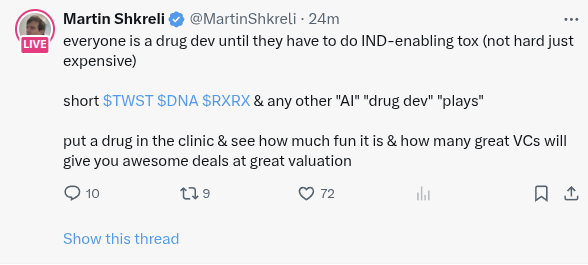
“everyone is a drug dev until they have to do IND-enabling tox (not hard just expensive)
short $TWST $DNA $RXRX & any other “AI” “drug dev” “plays”
put a drug in the clinic & see how much fun it is & how many great VCs will give you awesome deals at great valuation” — Martin Shkreli (@MartinShkreli), October 5, 2026
Coming from someone with deep experience operating drug companies (Retrophin, Turing Pharmaceuticals) and analyzing biotech balance sheets, the tweet cuts directly to the core existential question facing the multi-billion-dollar TechBio sector:
Can machine learning algorithms and computational biology bypass the unforgiving, capital-draining physical laws of pharmacology, toxicology, and human clinical trials? Or is the entire sector a venture-capital-inflated mirage destined to collapse upon contact with real human pathophysiology?
Furthermore, are Twist Bioscience ($TWST), Ginkgo Bioworks ($DNA), and Recursion Pharmaceuticals ($RXRX) actually the right targets for this short thesis?
We conducted a comprehensive, data-driven investigation into the regulatory mechanics of IND-enabling toxicology, clinical attrition benchmarks, and the audited balance sheets and operational models of all three companies. Here is our forensic audit, comparative valuation breakdown, and final verdict on whether Shkreli’s call has solid ground to stand on.
1. Deconstructing Shkreli’s Post: The Three Core Assertions
Shkreli’s post is not merely an emotional rant; it contains three distinct, testable claims regarding drug development economics, regulatory biology, and venture capital market dynamics:
┌─────────────────────────────────────────────────────────────────────────────────────────────────┐
│                     DECONSTRUCTING SHKRELI'S "AI DRUG DEV" SHORT THESIS                         │
├────────────────────────┬───────────────────────────────────┬────────────────────────────────────┤
│ Claim                  │ Shkreli's Assertion               │ Underlying Market Dynamic          │
├────────────────────────┼───────────────────────────────────┼────────────────────────────────────┤
│ 1. The IND Tox Filter  │ "everyone is a drug dev until     │ In silico algorithms find hits,    │
│                        │ they have to do IND-enabling      │ but GLP toxicology in animals is a │
│                        │ tox (not hard just expensive)"    │ rigid, non-negotiable cash drain.  │
├────────────────────────┼───────────────────────────────────┼────────────────────────────────────┤
│ 2. The Clinical Wall   │ "put a drug in the clinic & see   │ Clinical Phase 2 proof-of-concept  │
│                        │ how much fun it is"               │ destroys 75%+ of assets, rendering │
│                        │                                   │ computational "efficiency" moot.   │
├────────────────────────┼───────────────────────────────────┼────────────────────────────────────┤
│ 3. VC Valuation Bubble │ "see how many great VCs will give │ Platform tech multiples (20x-50x)  │
│                        │ you awesome deals at great        │ implode into biotech DCF models    │
│                        │ valuation"                        │ when assets stall or fail.         │
└────────────────────────┴───────────────────────────────────┴────────────────────────────────────┘
To determine whether Shkreli is right, we must first examine what IND-enabling tox actually is and why it serves as the ultimate “meat grinder” for Silicon Valley software models.
2. Regulatory & Scientific Audit: What Is “IND-Enabling Tox” and Why Does It Break AI?
In drug development, anyone with a high-performance GPU cluster, a diffusion model, or an AlphaFold-derived protein structure can generate billions of virtual molecules that dock with high theoretical binding affinity into a target pocket. In silico hit generation has indeed become vastly faster and cheaper.
However, the FDA and global health authorities (under 21 CFR Part 312 and ICH Guidelines M3(R2)) do not approve code. Before a single human volunteer can be dosed with a New Chemical Entity (NCE), the sponsor must file an Investigational New Drug (IND) application containing a complete Good Laboratory Practice (GLP) toxicology dossier.
The Prescriptive Playbook: Why Shkreli Says It’s “Not Hard”
Shkreli notes parenthetically that IND-enabling tox is (not hard just expensive). Pharmacologically, he is correct: IND-enabling toxicology is not an intellectual research exercise; it is a rigid, prescriptive regulatory compliance checklist.
To clear an IND, a sponsor must execute a standardized battery of studies mandated by international regulatory harmonisation:
                      THE PRECLINICAL IND-ENABLING TOXICOLOGY BATTERY
                                (ICH M3(R2) & 21 CFR § 312)
                                             │
      ┌──────────────────────┬───────────────┴───────────────┬──────────────────────┐
      ▼                      ▼                               ▼                      ▼
[ Repeat-Dose Tox ]  [ Safety Pharmacology ]         [ Genotoxicity ]        [ ADME & CMC ]
  • Rodent (Rat):       • Cardiovascular:               • Bacterial Reverse     • GLP/GMP kg-scale
    14- or 28-day         hERG patch-clamp                Mutation (Ames)         batch synthesis
    GLP repeat dose       conscious telemetry           • In vitro Mammalian    • Solid-state salt &
  • Non-Rodent:         • Respiratory:                    Chromosomal Aberr.      polymorph screening
    Cyno Monkey or        Plethysmography               • In vivo Rat           • Formulation stability
    Beagle Dog          • Central Nervous System:         Micronucleus Assay      & bioanalytical assay
  • Toxicokinetics        Irwin Battery test                                      validation
(TK) & Necropsy- Repeat-Dose GLP Toxicity: Repeated dosing for 14 to 28 days in two mammalian species (one rodent, typically Sprague-Dawley rats; one non-rodent, typically cynomolgus macaques or beagle dogs). Every animal is sacrificed, necropsied, and over 40 distinct organs undergo comprehensive histopathological evaluation to identify the No Observed Adverse Effect Level (NOAEL).
- Safety Pharmacology (ICH S7A/B): The core battery assessing vital organ function:
- Cardiovascular: In vitro hERG potassium channel assay (to rule out QT prolongation and lethal Torsades de Pointes arrhythmia) and in vivo telemetry in conscious dogs or monkeys.
- Central Nervous System: Modified Irwin behavioral screening in rodents.
- Respiratory: Whole-body plethysmography evaluating tidal volume and respiration rate.
- Genotoxicity (ICH S2(R1)): Three-tier mutagenicity testing: the Ames Salmonella bacterial reverse mutation test, in vitro chromosomal aberration/mouse lymphoma, and in vivo rat erythrocyte micronucleus assay.
- Bioanalytical & CMC Characterization: Developing validated GLP liquid chromatography-tandem mass spectrometry (LC-MS/MS) assays to measure plasma drug concentrations, establishing GLP drug substance stability, and synthesizing kilogram-scale active pharmaceutical ingredients (API) under strict purity specifications.
Why It Is “Just Expensive” (The Capital Black Hole)
There is no machine-learning shortcut to testing whether a chemical causes liver necrosis in a live primate.
- CRO Capacity & Hard Costs: Running a single, full IND-enabling GLP package at a specialized Contract Research Organization (CRO) such as Charles River Laboratories, Labcorp, or WuXi AppTec costs $2.5 million to $5.0 million in cash per molecule.
- The Non-Human Primate (NHP) Supply Bottleneck: Post-pandemic supply restrictions on cynomolgus macaques pushed the cost of a single research primate to $30,000–$50,000, compounding animal facility overhead.
- Kilogram-Scale Synthesis: Producing GLP-grade synthetic chemical batches with documented Certificate of Analysis (CoA) purity adds another $1.0M–$2.5M.
- Time: Even with expedited CRO scheduling, in-life dosing, recovery arms, slide preparation, bioanalysis, and final GLP audited reporting require 9 to 18 months.
The “Great Filter”: Why AI Fails at IND Tox
Here is where Shkreli’s critique gains immense scientific weight. An AI model can optimize for in vitro binding affinity ($K_i$ or $IC_{50}$) against a static protein crystal structure. But in vivo animal biology is non-linear and deeply interconnected:
- Reactive Metabolite Formation: A computationally optimized molecule may be non-toxic in parent form, but upon hepatic metabolism by cytochrome P450 enzymes (e.g., CYP3A4, CYP2D6), it forms reactive quinone imines or epoxides that bind covalently to hepatocytes, causing severe liver injury.
- Phospholipidosis and Lysosomal Trapping: Basic lipophilic compounds designed by generative models frequently accumulate inside lysosomes, triggering tissue-wide vacuolation.
- hERG Channel Liability: Subtle electrostatic interactions frequently cause structurally novel molecules to block the cardiac hERG channel, generating prohibitive cardiotoxic signals that halt development.
- Poor Bioavailability & Insoluble Formulation: AI models frequently design lipophilic molecules with terrible aqueous solubility that cannot be formulated into stable solutions for animal oral gavage or intravenous delivery.
When an AI company generates 50 promising hits in silico, it cannot simply run all 50 through IND-enabling tox. Doing so would consume $150 million to $250 million in pure cash. As a result, the computational “abundance” promised by AI collapses the moment physical reality demands capital.
3. The Clinical Attrition Meat Grinder: “Put a Drug in the Clinic & See How Much Fun It Is”
If clearing IND-enabling tox is an expensive filter, entering human clinical trials is an outright graveyard.
The TechBio investment narrative rested on the assertion that AI would dramatically improve the Probability of Success (POS) in clinical trials:
                             THE TRADITIONAL VS. AI CLINICAL REALITY
┌────────────────────────────────┬───────────────────────────┬───────────────────────────┐
│ Clinical Phase                 │ Industry Historical POS   │ AI-Discovered Assets POS  │
├────────────────────────────────┼───────────────────────────┼───────────────────────────┤
│ Phase 1 (Safety/Tolerability)  │ ~70% – 80%                │ ~80% – 85%                │
├────────────────────────────────┼───────────────────────────┼───────────────────────────┤
│ Phase 2 (Proof of Concept)     │ ~25% – 32%                │ ~20% – 28%                │
├────────────────────────────────┼───────────────────────────┼───────────────────────────┤
│ Phase 3 (Pivotal Efficacy)     │ ~50% – 60%                │ Insufficient Data / ~50%  │
├────────────────────────────────┼───────────────────────────┼───────────────────────────┤
│ Overall Lead-to-Approval       │ ~7% – 10%                 │ ~5% – 8%                  │
└────────────────────────────────┴───────────────────────────┴───────────────────────────┘
Why Phase 1 Gives a False Sense of Victory
AI drug discovery proponents frequently celebrate high Phase 1 success rates. But Phase 1 merely tests safety, tolerability, and pharmacokinetics in a small cohort (20–80) of healthy human volunteers. If a molecule survived GLP toxicology, it will almost certainly be reasonably well-tolerated in healthy young adults at modest doses.
The Phase 2 Brick Wall: The Target Validation Crisis
The true “Valley of Death” in pharmaceutical development is Phase 2, where the drug is administered to hundreds of real patients suffering from the target disease to determine whether it provides therapeutic efficacy.
Industry-wide benchmark studies published in Nature Reviews Drug Discovery and analyses by BCG reveal that nearly 75% of all Phase 2 clinical trials fail. Crucially, the overwhelming cause of Phase 2 failure (>60%) is lack of efficacy, not toxicity.
Why does AI fail here? Because the bottleneck in modern medicine was never molecular design—it was target validation. If an AI designs a chemically flawless, picomolar-affinity binder to Target X, but Target X does not actually drive disease pathology in heterogeneous human patients (due to redundant biological pathways, genetic polymorphisms, or compensatory feedback mechanisms), the clinical trial will fail completely.
An algorithm trained on historical biomedical literature and in vitro assays merely amplifies the underlying scientific biases of the literature. It cannot predict the messy, non-linear emergent dynamics of human disease.
4. Company Deep Dive 1: Recursion Pharmaceuticals ($RXRX) — The Direct Confirmation
If there is one company that personifies Shkreli’s exact criticism, it is Recursion Pharmaceuticals (NASDAQ: RXRX).
┌─────────────────────────────────────────────────────────────────────────────────────────────────┐
│                        RECURSION PHARMACEUTICALS ($RXRX) FORENSIC PROFILE                       │
├─────────────────────────────────────────┬───────────────────────────────────────────────────────┤
│ Metric                                  │ Data / Status (As of October 2026)                    │
├─────────────────────────────────────────┼───────────────────────────────────────────────────────┤
│ Stock Price                             │ $4.53                                                 │
│ Market Capitalization                   │ $2.18 Billion                                         │
│ Cash & Marketable Securities            │ ~$557 Million (Mid-2026)                              │
│ Guided 2026 Cash Operating Expenses     │ < $390 Million (Post-restructuring)                   │
│ Cash Runway                             │ Into Early 2028                                       │
│ Notable Acquisitions                    │ Exscientia ($688M all-stock merger, closed Nov 2024)  │
│ Big Tech / Pharma Partnerships          │ NVIDIA, Roche, Genentech, Sanofi, Bayer               │
└─────────────────────────────────────────┴───────────────────────────────────────────────────────┘
The Industrialized Vision
Recursion was founded on the revolutionary premise that human biology could be mapped through industrial automation. By combining automated robotic wet-labs that take millions of cellular microscopy images per week with supercomputing clusters (BioHive-1 and BioHive-2, powered by thousands of NVIDIA H100 GPUs), Recursion extracts morphological feature embeddings to predict disease reversal without needing hypothesis-driven biology. In late 2024, it acquired UK-based AI pioneer Exscientia for $688 million to combine its phenotypic screening with Exscientia’s generative chemistry platform.
What Happened When Recursion Put Drugs in the Clinic?
Recursion did precisely what Shkreli dared the industry to do: it pushed internal, AI-discovered and phenotypically optimized candidates into human clinical trials.
The result was an undeniable vindication of the biotech cynics:
In May 2025, Recursion announced a sweeping strategic pipeline reprioritization in which it permanently discontinued its three most advanced proprietary clinical programs:
- REC-994 (Cerebral Cavernous Malformation - Phase 2 SYCAMORE trial): After years of hype, the Phase 2 trial demonstrated acceptable safety, but failed to produce definitive clinical efficacy or biomarker-proven reduction in lesion volume, forcing the company to shelve the program.
- REC-2282 (Neurofibromatosis Type 2 - Phase 2/3): Axed due to trial recruitment burdens, clinical feasibility challenges, and questionable commercial viability.
- REC-3964 (Clostridioides difficile infection - Phase 2): Terminated during clinical reprioritization.
These three programs were not obscure side-projects; they were Recursion’s pioneer proofs-of-concept presented to public investors to validate the entire “Recursion OS” platform. When they met human clinical endpoints, the phenotypic supercomputer failed to alter the historical laws of clinical attrition.
Financial Reality: Software Story, Biotech Burn
Recursion’s financial profile illustrates the fundamental flaw of TechBio valuations:
- Despite cutting cash operating expenses by nearly 40% (guiding 2026 cash opex below $390M), the company continues to burn substantial capital.
- Its commercial revenue consists almost exclusively of upfront milestone payments and research fees from partners (Roche, Sanofi).
- While its balance sheet ($557M cash) extends its runway into 2028, it faces an ongoing treadmill of high capital consumption to fund clinical development for its remaining pipeline candidates (REC-4881 in familial adenomatous polyposis, REC-1245, REC-4539).
Verdict on RXRX: Shkreli is 100% justified. Recursion’s multi-year journey from high-flying Silicon Valley darling to axing its lead clinical assets at $4.53 per share is textbook proof of his thesis.
5. Company Deep Dive 2: Ginkgo Bioworks ($DNA) — The SPAC Foundry That Cratered
Martin Shkreli next singles out Ginkgo Bioworks Holdings (NYSE: DNA). But does Ginkgo even fit his description?
┌─────────────────────────────────────────────────────────────────────────────────────────────────┐
│                          GINKGO BIOWORKS ($DNA) FORENSIC PROFILE                                │
├─────────────────────────────────────────┬───────────────────────────────────────────────────────┤
│ Metric                                  │ Data / Status (As of October 2026)                    │
├─────────────────────────────────────────┼───────────────────────────────────────────────────────┤
│ Stock Price                             │ $14.88 – $14.93                                       │
│ Pre-Split Equivalent Price              │ ~$0.37 (Adjusted for 1-for-40 Reverse Split)          │
│ Market Capitalization                   │ ~$830 Million (Down from >$15 Billion peak)           │
│ Cash & Liquid Assets                    │ $302 Million (+ $87M restricted) (As of Q2 2026)      │
│ Guided 2026 Full-Year Cash Burn         │ $125 Million – $150 Million                           │
│ Q2 2026 GAAP Net Loss                   │ -$57.3 Million (Adjusted EBITDA loss -$36.3M)         │
│ Corporate Restructuring                 │ Divested Biosecurity (Apr 2026); automated lab pivot  │
└─────────────────────────────────────────┴───────────────────────────────────────────────────────┘
The Foundry Model: Ginkgo Never Wanted to Be a Drug Dev
Here, Shkreli makes a categorical error: Ginkgo Bioworks is not an internal drug developer.
Ginkgo was designed from day one to explicitly avoid taking drugs into IND-enabling tox or clinical trials! Ginkgo’s model was the “AWS of synthetic biology”:
- Ginkgo built massive automated bio-foundries to genetically engineer microbes, yeast, and mammalian cells for third parties.
- Partners (spanning agriculture, industrial chemicals, fragrance, and biopharma) paid Ginkgo platform fees and granted downstream royalties or equity stakes.
- Ginkgo never intended to spend $50M running Phase 2 trials.
The Collapse of the “Biology as Code” Dream
Even though Ginkgo is not a drug developer, Shkreli’s contempt for its valuation is grounded in reality. Ginkgo was the supreme poster child for Silicon Valley hubris:
- In 2021, Ginkgo went public via Harry Sloan’s SPAC (Soaring Eagle Acquisition Corp) at a dizzying $15+ billion valuation (peaking above $25 billion).
- Prominent tech investors heralded Ginkgo’s “data flywheel,” claiming organism programming would scale with Moore’s Law.
- But biology resisted automation. Downstream commercial royalties completely failed to materialize in meaningful cash flows. Foundry revenues stagnated, and the company burned hundreds of millions per year on massive robotic facilities.
- Short-sellers (most notably Scorpion Capital in 2021) attacked the company, alleging that its revenues were inflated through related-party transactions with startups funded by Ginkgo itself.
- By mid-2024, the stock had plummeted by over 95%, trading well below $1.00 per share.
- In August 2024, Ginkgo was forced to execute a humiliating 1-for-40 reverse stock split to avoid delisting from the NYSE.
2026 Status: A Restructured Shell
By late 2026, Ginkgo has drastically pared down. It completed the divestiture of its pandemic-era biosecurity unit in April 2026, shuttered non-essential programs, reduced full-year cash burn guidance to $125M–$150M, and is trying to reposition itself around “Nebula” autonomous cloud laboratories.
Verdict on DNA: Shkreli is thematically right about the collapse of synthetic biology VC hype, but conceptually inaccurate in his specific technical critique. Ginkgo never ran an internal drug into IND tox. Furthermore, shorting Ginkgo today at an $830M valuation after a 95% destruction of capital is closing the barn door four years late.
6. Company Deep Dive 3: Twist Bioscience ($TWST) — The Tools Provider in an AI Speculative Bubble
Shkreli’s third target is Twist Bioscience (NASDAQ: TWST). This is where his analysis requires the most critical scrutiny:
┌─────────────────────────────────────────────────────────────────────────────────────────────────┐
│                         TWIST BIOSCIENCE ($TWST) FORENSIC PROFILE                               │
├─────────────────────────────────────────┬───────────────────────────────────────────────────────┤
│ Metric                                  │ Data / Status (As of October 2026)                    │
├─────────────────────────────────────────┼───────────────────────────────────────────────────────┤
│ Stock Price                             │ $202.36 (Near All-Time Highs)                         │
│ Market Capitalization                   │ ~$12.50 Billion                                       │
│ Fiscal 2025 Revenue                     │ $376.6 Million (+20.3% YoY)                           │
│ Guided Fiscal 2026 Revenue              │ $456 Million – $457 Million                           │
│ Adjusted Gross Margin                   │ 52.8% (Targeting >52% sustained)                      │
│ Profitability Status                    │ Targeting Adj. EBITDA breakeven Q4 FY26; GAAP loss    │
│ Recent Financing                        │ Upsized $300 Million public offering (August 2026)    │
│ Key Catalysts                           │ Eli Lilly TuneLab AI partnership; Express Genes scale │
└─────────────────────────────────────────┴───────────────────────────────────────────────────────┘
The Business Model: Pure “Picks and Shovels”
Twist Bioscience is not an “AI drug dev play” by any standard definition.
Twist does not develop, own, or sponsor clinical drug candidates. Twist is a hardware and chemistry manufacturing foundry. Its proprietary innovation is a silicon-based semiconductor synthesis platform that synthesizes DNA on silicon chips rather than traditional 96-well plastic plates, miniaturizing reaction volumes by a factor of 99.8% and drastically reducing synthesis costs.
Twist generates high-margin commercial revenue across three core segments:
- Synthetic Genes & Oligo Pools: Physical DNA ordered by academic researchers, biotech startups, and Big Pharma.
- Next-Generation Sequencing (NGS) Target Enrichment: Consumable probe kits used by liquid biopsy and genetic testing companies.
- Biopharma Solutions: In vitro antibody discovery and characterization services performed under contract for partners.
Twist does not pay for IND-enabling toxicology. Twist does not fund Phase 1, Phase 2, or Phase 3 trials. When an AI drug discovery company or a pharma company wants to test 5,000 synthetic DNA sequences or screen antibody libraries, they write a check to Twist. If the resulting drug dies in IND tox, Twist already collected its cash.
So Why Does Shkreli Want to Short It? The 2026 Parabolic Bubble
If Twist is a tools company, why did Shkreli put $TWST at the very top of his short list?
The answer lies in market valuation and the speculative frenzy of autumn 2026:
- In September and October 2026, $TWST went on a ferocious, parabolic rally, soaring from $121 to over $202 per share.
- The primary catalyst was the aggressive promotion of Twist’s partnership with Eli Lilly’s AI/ML platform, TuneLab, in which Twist provides high-throughput antibody characterization data to train Lilly’s generative models.
- Wall Street analysts latched onto the “AI picks-and-shovels” narrative, ratcheting price targets up to $212.
- At $202 per share, Twist’s market capitalization reached $12.5 Billion.
The Financial Disconnect: 27x Sales for a Hardware Manufacturer
Look at Twist’s audited financial fundamentals against that $12.5B valuation:
- Revenue: Guided at ~$456M for FY2026. A $12.5B market cap means TWST is trading at over 27 times forward sales!
- Gross Margins: While healthy at 52.8%, a 53% gross margin is the profile of a precision manufacturing business, not a software company with 85% gross margins.
- GAAP Losses & Free Cash Flow: Twist remains unprofitable on a GAAP basis (reporting an adjusted EBITDA loss of $11.3M in Q3 FY26), with full GAAP net profitability not projected until 2029.
- Dilution: To fund its capital expenditures, Twist executed an upsized $300 Million equity dilution offering in August 2026.
Verdict on TWST: Shkreli is scientifically wrong about Twist being an “AI drug dev” that has to do IND tox, but financially brilliant if viewing TWST as an absurdly overstretched speculative bubble. Trading at 27x sales with ongoing cash burn, TWST is priced for perfection on AI coattails. If the AI drug discovery sector cools down, TWST’s multiple will compress violently.
7. Comparative Company Matrix: Shkreli’s Short Basket Audited
To understand the sector at a glance, here is how the three companies compare across scientific exposure, business model, and valuation risk:
┌─────────────────────────────────────────────────────────────────────────────────────────────────┐
│                         SHKRELI'S TARGETS: COMPARATIVE FORENSIC MATRIX                          │
├───────────────────────┬─────────────────────────┬───────────────────────┬───────────────────────┤
│ Dimension             │ Recursion ($RXRX)       │ Ginkgo ($DNA)         │ Twist ($TWST)         │
├───────────────────────┼─────────────────────────┼───────────────────────┼───────────────────────┤
│ Core Business Model   │ AI Phenomics & Pipeline │ Cell Foundry & Cloud  │ Silicon DNA Synthesis │
│                       │ Clinical Drug Sponsor   │ Laboratory Automation │ Tools & Consumables   │
├───────────────────────┼─────────────────────────┼───────────────────────┼───────────────────────┤
│ Does it do IND Tox?   │ YES — Core internal     │ NO — Third-party      │ NO — Consumable       │
│                       │ pipeline liability      │ customers execute tox │ customers execute tox │
├───────────────────────┼─────────────────────────┼───────────────────────┼───────────────────────┤
│ Clinical Track Record │ Lead 3 programs axed in │ No internal clinical  │ No internal clinical  │
│                       │ May 2025 (REC-994, etc) │ pipeline              │ pipeline              │
├───────────────────────┼─────────────────────────┼───────────────────────┼───────────────────────┤
│ Current Market Cap    │ $2.18 Billion           │ $0.83 Billion         │ $12.50 Billion        │
├───────────────────────┼─────────────────────────┼───────────────────────┼───────────────────────┤
│ Forward P/S Ratio     │ ~20x – 25x              │ ~4x – 5x              │ ~27.4x                │
├───────────────────────┼─────────────────────────┼───────────────────────┼───────────────────────┤
│ Cash Position         │ $557M (Mid-2026)        │ $302M (Q2 2026)       │ $167M + $300M raise   │
├───────────────────────┼─────────────────────────┼───────────────────────┼───────────────────────┤
│ Shkreli Thesis Fit    │ 100% Direct Bullseye    │ Thematic Fit / Mis-   │ Category Mistake /    │
│                       │                         │ classified Model      │ Extreme Valuation Top │
└───────────────────────┴─────────────────────────┴───────────────────────┴───────────────────────┘
8. The VC Incentive Misalignment: Why “TechBio” Stumbled
Shkreli closes his post with a biting critique of venture capital:
“see how much fun it is & how many great VCs will give you awesome deals at great valuation”
This statement captures a fundamental structural pathology that has plagued biotechnology investing over the past six years: the cultural and financial clash between Silicon Valley Tech VCs and Traditional Biotech Specialists.
                     THE TECH VC VS. BIOTECH SPECIALIST MINDSET
┌───────────────────────────────────┬───────────────────────────────────┐
│ Silicon Valley Tech VCs (A16Z,    │ Specialist Biotech Funds (OrbiMed,│
│ SoftBank, Founders Fund)          │ Baker Bros, RA Capital)           │
├───────────────────────────────────┼───────────────────────────────────┤
│ • Treats biology as an "inform-   │ • Treats biology as an empirical, │
│   ation science" / code to hack   │   stochastic physiological system │
│ • Evaluates platforms on compute, │ • Evaluates pipelines on Target   │
│   datasets, and "flywheels"       │   Engagement, PK/PD, and POS      │
│ • Accustomed to 80% SaaS margins  │ • Accustomed to clinical binary   │
│   and fast iteration cycles       │   risk and heavy capital burn     │
│ • Uses forward ARR multiples to   │ • Uses risk-adjusted Net Present  │
│   justify $10B+ valuations        │   Value (rNPV) discounted at 15% │
│ • Flees at the first Phase 2      │ • Builds structures for trial     │
│   clinical endpoint failure       │   setbacks and down-rounds        │
└───────────────────────────────────┴───────────────────────────────────┘
Between 2019 and 2022, Silicon Valley venture capitalists applied software heuristics to drug discovery. They pumped tens of billions of dollars into platform biotechs at astronomical valuations, believing that machine learning algorithms would generate exponential returns with near-zero marginal costs.
When those companies went public or pushed candidates into IND-enabling studies and Phase 1/2 trials, the tech VCs discovered that:
- You cannot “A/B test” a molecule in a patient’s liver.
- Clinical trial costs are linear and physical, not digital. You must pay contract research organizations, clinical coordinators, IRBs, and hospital sites cash for every patient visit.
- When a clinical trial misses its primary endpoint, the asset’s value drops to zero instantaneously. You cannot “pivot” a failed Phase 2 molecule into a new enterprise SaaS tier.
As early platform trials failed throughout 2024 and 2025, tech VCs retreated from the sector. When early-stage AI biotechs return to the private market today needing $50 million to fund a Phase 2 trial, the VCs who praised their algorithms are nowhere to be found—or they demand punitive down-rounds with 3x liquidation preferences.
9. Our Independent Verdict: Do We Agree or Disagree with Martin Shkreli?
Having evaluated the science of IND-enabling toxicology, the clinical attrition statistics, and the corporate profiles of all three companies, here is our definitive verdict:
Overall Stance: NUANCED AGREEMENT (STRONG ON THESIS & RXRX; MIXED ON TWST & DNA MECHANICS)
┌─────────────────────────────────────────────────────────────────────────────────────────────────┐
│                                 THE FINAL INDEPENDENT VERDICT                                   │
├──────────────────────────┬───────────┬──────────────────────────────────────────────────────────┤
│ Core Thesis Element      │ Verdict   │ Rationale & Evidence                                     │
├──────────────────────────┼───────────┼──────────────────────────────────────────────────────────┤
│ 1. IND Tox & Clinical    │ AGREE     │ Preclinical tox and Phase 2 efficacy remain the ultimate │
│    Filter Reality        │ (Strong)  │ capital and biological filters; AI does not bypass them. │
├──────────────────────────┼───────────┼──────────────────────────────────────────────────────────┤
│ 2. Short Recursion       │ AGREE     │ Core proprietary pipeline was gutted in May 2025; heavy  │
│    ($RXRX)               │ (Strong)  │ burn persists with unproven clinical differentiation.    │
├──────────────────────────┼───────────┼──────────────────────────────────────────────────────────┤
│ 3. Short Twist           │ AGREE ON  │ Shkreli misclassifies TWST as an IND drug developer, but │
│    Bioscience ($TWST)    │ VALUATION │ shorting at $202 (27x P/S, $12.5B cap) on Lilly AI hype  │
│                          │ ONLY      │ is an exceptional tactical valuation short.              │
├──────────────────────────┼───────────┼──────────────────────────────────────────────────────────┤
│ 4. Short Ginkgo          │ DISAGREE  │ The short is 4 years too late; stock already collapsed   │
│    Bioworks ($DNA)       │ (Timing)  │ 95% into an $830M cap post-split. DNA doesn't run INDs. │
└──────────────────────────┴───────────┴──────────────────────────────────────────────────────────┘
1. Where Shkreli Is 100% Right: The Scientific & Economic Thesis
Martin Shkreli is fundamentally correct on the macro reality of drug development. The TechBio narrative sold the public on the illusion that drug development is a software engineering problem. It is not. It is an empirical biological problem.
- IND-enabling tox is an unavoidable, non-negotiable cash gatekeeper.
- AI has failed to demonstrate superior Phase 2 clinical proof-of-concept success rates over traditional medicinal chemistry.
- Silicon Valley VCs have largely abandoned the fantasy of easy TechBio deals, leaving platform biotechs facing brutal down-rounds.
2. Where Shkreli Hits the Bullseye: Recursion ($RXRX)
Shorting $RXRX is a textbook execution of Shkreli’s thesis. Recursion’s decision in May 2025 to cancel REC-994, REC-2282, and REC-3964 proved that hundreds of millions of dollars in supercomputing infrastructure could not prevent clinical trial failure. With high operating expenses and unproven clinical assets, RXRX remains highly vulnerable.
3. Where Shkreli Is Right for the Wrong Reason: Twist Bioscience ($TWST)
Shkreli’s classification of Twist as an “AI drug dev play” that will fail IND tox is factually wrong. Twist is a physical tools supplier that profits whether its customers’ drugs succeed or fail. However, as an investment short, $TWST at $202+ is extraordinarily compelling. Trading at 27x forward revenue with GAAP net losses and a $12.5 billion market capitalization driven by AI hype, Twist is drastically disconnected from the reality of its 53% gross margin hardware manufacturing business. If the AI biotech bubble deflates, TWST has massive downside.
4. Where Shkreli Stumbles: Ginkgo Bioworks ($DNA)
Ginkgo is neither an IND drug developer nor an attractive short candidate today. Ginkgo already completed its boom-and-bust cycle. Its stock collapsed from $15B to $830M, it executed a 1-for-40 reverse split, and it is holding $300M in cash. Shorting a low-dollar, heavily shorted equity that has already lost 95% of its value exposes an investor to severe borrow fees and violent bear-market squeeze risk.
10. The Strategic Investor Takeaway: Navigating the Post-Hype TechBio Era
The takeaway from Shkreli’s warning is not that artificial intelligence has no role in medicine. Deep learning is already indispensable for protein structure prediction, cryo-EM image reconstruction, and lead optimization.
Instead, the lesson is how to value biotechnology companies in the post-hype era:
- Beware the “Platform Tech” Multiple: Never pay 25x–50x revenue for a biotech company claiming its “platform” solves disease. Biotech assets can only be valued on risk-adjusted Net Present Value (rNPV) of clinical programs.
- Distinguish Tools from Sponsors: Companies that sell physical tools (like Twist) have durable, real businesses, but must be priced like industrial manufacturing companies (3x–6x revenue), not software monopolies (30x revenue).
- The Clinic Is King: In biopharma, nothing matters until double-blind, placebo-controlled Phase 2 clinical data proves therapeutic efficacy and safety in human patients. Everything before that—no matter how many GPUs or transformer layers were used—is simply pre-clinical speculation.