On October 7, 2026, veteran biotechnology journalist Adam Feuerstein posted an incisive dispatch on X that cut straight through the corporate euphemisms surrounding the sudden collapse of Caribou Biosciences (NASDAQ: CRBU):
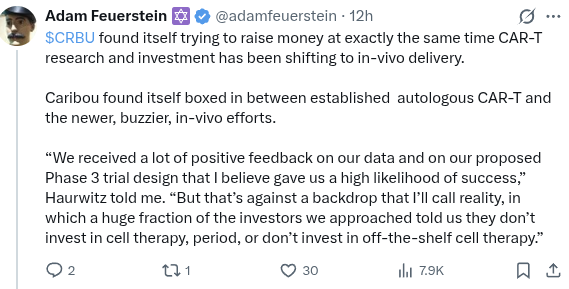
“$CRBU found itself trying to raise money at exactly the same time CAR-T research and investment has been shifting to in-vivo delivery.
Caribou found itself boxed in between established autologous CAR-T and the newer, buzzier, in-vivo efforts.
‘We received a lot of positive feedback on our data and on our proposed Phase 3 trial design that I believe gave us a high likelihood of success,’ Haurwitz told me. ‘But that’s against a backdrop that I’ll call reality, in which a huge fraction of the investors we approached told us they don’t invest in cell therapy, period, or don’t invest in off-the-shelf cell therapy.’“
— Adam Feuerstein (@adamfeuerstein), October 7, 2026
For anyone tracking the biotechnology capital markets, Dr. Rachel Haurwitz’s candid admission to Feuerstein is an industry-defining quote.
Just twenty-four hours earlier, Caribou—co-founded by CRISPR pioneer and Nobel laureate Dr. Jennifer Doudna—had shocked Wall Street by terminating its entire allogeneic CAR-T clinical pipeline, slashing its workforce, incurring $15M–$19M in restructuring charges, and hiring Wedbush Securities to explore “strategic alternatives” (a sale or liquidation) as its shares plunged below $0.70.
Yet, as Haurwitz acknowledged, Caribou’s failure was not caused by bad Phase 1 data. Its lead candidate, vispa-cel (CB-010), posted an 82% overall response rate (ORR) and a 17.1-month median progression-free survival (mPFS) in an optimized patient cohort. CB-011 achieved an 83% complete response rate in multiple myeloma.
Instead, Caribou collided head-first with what Haurwitz aptly termed “reality”: an institutional investor strike against ex-vivo allogeneic cell therapy, driven by the explosive emergence of In Vivo CAR-T—the direct genetic reprogramming of human immune cells inside the living patient’s body.
Caribou did not perish because cell therapy died. It perished because it was caught in the “Squeezed Middle”—trapped between an entrenched autologous CAR-T fortress on one side and a multi-billion dollar in-vivo genetic revolution on the other.
┌──────────────────────────────────────────────────────────────────────────────────────────────────┐
│              THE CELL THERAPY SQUEEZE: WHY EX-VIVO ALLOGENEIC GOT CRUSHED IN 2026                │
├───────────────────────────────┬──────────────────────────────────┬───────────────────────────────┤
│ THE AUTOLOGOUS FORTRESS       │ THE SQUEEZED MIDDLE (ALLOGENEIC) │ THE IN-VIVO REVOLUTION        │
│ (Yescarta, Carvykti, Breyanzi)│ (Caribou, Allogene, Sana ex-vivo)│ (Kelonia, Capstan, Umoja)     │
├───────────────────────────────┼──────────────────────────────────┼───────────────────────────────┤
│ • Curative survival plateaus  │ • Durability cliff: donor cells  │ • Zero ex-vivo manufacturing  │
│ • Vein-to-vein cut to 10-14d  │   cleared in 3-6 months          │ • No apheresis required       │
│ • Established hospital infra  │ • Forced into HLA-matching       │ • No lymphodepletion chemo    │
│ • Commercial reimbursement    │ • Toxic lymphodepletion needed   │ • Outpatient IV infusion      │
│ • Big Pharma cash cows ($5B+) │ • Capital drought / Liquidations │ • $10B+ Pharma M&A (2024-2026)│
└───────────────────────────────┴──────────────────────────────────┴───────────────────────────────┘
1. Forensic Anatomy: The ‘Squeezed Middle’ Paradox
To understand why institutional biotech funds slammed their checkbooks shut on Caribou, one must analyze the unforgiving competitive mechanics of the cell therapy ecosystem in 2026.
For nearly a decade, the biopharma industry operated under a seemingly simple commercial thesis:
“Autologous CAR-T is biologically miraculous, but commercially broken due to individualized vein-to-vein manufacturing and multi-week turnaround times. Therefore, whoever builds an off-the-shelf, healthy-donor allogeneic CAR-T will monopolize the oncology market.”
Between 2017 and 2021, Wall Street poured tens of billions of dollars into this thesis, propelling Caribou ($CRBU), Allogene ($ALLO), Cellectis ($CLLS), Poseida ($PSTX), and Sana ($SANA) to multi-billion-dollar valuations.
By 2026, however, both premises of that thesis completely unraveled:
Flank 1: The Autologous Fortress Got Faster and Stronger
The autologous pioneers did not stand still. Companies like Gilead/Kite (Yescarta, Tecartus), Bristol Myers Squibb (Breyanzi, Abecma), and Johnson & Johnson/Legend Biotech (Carvykti) systematically eliminated their logistical bottlenecks:
- Commercial vein-to-vein turnaround times dropped from 6–8 weeks to 10 to 14 days (supported by platforms like Novartis’s T-Charge and next-generation automated closed-system bioreactors).
- Autologous CAR-Ts demonstrated curative, multi-year progression-free survival plateaus, with 5-year and 10-year cure rates in lymphomas and leukemias.
- Treating oncologists at academic medical centers built established clinical workflows and lucrative institutional billing codes around these products.
Flank 2: The Biological “Durability Cliff” of Allogeneic Cells
Ex-vivo allogeneic CAR-Ts suffered from an inescapable immunological hurdle: host-versus-graft (HvG) rejection.
- Even when companies used sophisticated CRISPR or TALEN nucleases to knock out the T-cell receptor (
TRAC) to prevent Graft-versus-Host Disease (GvHD), the patient’s own intact immune system (host CD8+ cytotoxic T cells and Natural Killer cells reacting to “missing-self” HLA-null phenotypes) recognized the foreign donor cells and eliminated them within weeks to months. - As donor cells disappeared, durable remissions evaporated. While initial overall response rates (ORR) looked identical to autologous CAR-T at Day 28 (often >80%), median PFS routinely dropped off a cliff by Month 6.
The Fatal Patch: The HLA-Matching Trap
To stop this durability collapse, Caribou introduced an HLA-matching requirement for vispa-cel: patients had to match at least two HLA alleles with young donors (age <30) to sustain responses out to 17.1 months.
While scientifically clever, this was commercially fatal.
The entire premise of allogeneic cell therapy was universal, on-demand availability from the hospital pharmacy freezer. The moment Caribou required HLA-matching algorithms and donor sub-cohort stratification, it re-introduced matching delays and inventory fractionalization. It surrendered its single competitive advantage against autologous CAR-T—while still requiring intensive lymphodepleting chemotherapy (fludarabine/cyclophosphamide) that leaves patients severely neutropenic.
Simultaneously, off-the-shelf bispecific antibodies (e.g., AbbVie/Genmab’s Epkinly, Roche’s Columvi, Pfizer’s Elrexfio) captured the urgent, community-hospital convenience market without requiring any cell harvesting or lymphodepletion at all.
Allogeneic ex-vivo cell therapy found itself with neither the curative durability of autologous CAR-T nor the off-the-shelf simplicity of bispecifics.
2. Enter In Vivo CAR-T: Reprogramming the Living Human
While allogeneic biotechs struggled to keep foreign donor cells alive inside patients, an audacious biological paradigm emerged from academic labs at the University of Pennsylvania and Harvard: What if you never take the cells out of the human body at all?
Instead of extracting, washing, culturing, and re-infusing cells through a $500,000 cleanroom supply chain, In Vivo CAR-T delivers the genetic instructions directly into the patient via a single intravenous (IV) infusion.
Specialized delivery vehicles target the patient’s own endogenous, circulating T cells in situ, engineering them inside the bloodstream and lymphoid organs into tumor-hunting CAR-T cells.
┌──────────────────────────────────────────────────────────────────────────────────────────────────┐
│                   EX-VIVO CELL THERAPY VS. IN-VIVO GENETIC REPROGRAMMING                         │
├──────────────────────────────────────┬───────────────────────────────────────────────────────────┤
│ EX-VIVO CELL THERAPY (Old Paradigm)  │ IN-VIVO CELL THERAPY (The New Frontier)                   │
├──────────────────────────────────────┼───────────────────────────────────────────────────────────┤
│ 1. Leukapheresis (Harvesting T-cells)│ 1. Direct Intravenous Infusion (Off-the-shelf vial)       │
│ 2. Cold-chain transport to cleanroom │ 2. Targeted Delivery Vehicle enters systemic circulation  │
│ 3. Viral transduction / CRISPR edit  │ 3. Selective binding to surface CD3/CD8/CD4/CD7 on T-cells│
│ 4. 14-28 days of cell expansion     │ 4. Endosomal uptake & intracellular translation/expression│
│ 5. Cryopreservation & QC release     │ 5. Native T-cells transform into active CAR-Ts IN VIVO    │
│ 6. Toxic lymphodepletion (Flu/Cy)    │ 6. CAR-Ts expand and eradicate diseased cells in situ     │
│ 7. Inpatient hospital infusion & ICU │ 7. NO lymphodepletion, NO apheresis, OUTPATIENT delivery  │
└──────────────────────────────────────┴───────────────────────────────────────────────────────────┘
The Two Technological Pillars of In Vivo CAR-T
In vivo cell therapy has bifurcated into two primary engineering approaches, each suited to distinct therapeutic indications:
┌──────────────────────────────────────────────────────────────────────────────────────────────────┐
│                         IN VIVO CAR-T: THE TWO MAJOR DELIVERY ARCHITECTURES                      │
├───────────────────────────────┬─────────────────────────────────┬────────────────────────────────┤
│ Feature                       │ Targeted Lipid Nanoparticles    │ Targeted Engineered Viruses    │
│                               │ (tLNP) + mRNA / circular RNA    │ (Targeted Lentivirus / iLenti) │
├───────────────────────────────┼─────────────────────────────────┼────────────────────────────────┤
│ Leading Pioneers              │ Capstan Therapeutics (AbbVie),  │ Kelonia Therapeutics (Lilly),  │
│                               │ Orna Therapeutics (Merck)       │ Umoja Biopharma (AbbVie)       │
├───────────────────────────────┼─────────────────────────────────┼────────────────────────────────┤
│ Genetic Cargo                 │ mRNA or circular RNA (circRNA)  │ CAR transgene cDNA             │
├───────────────────────────────┼─────────────────────────────────┼────────────────────────────────┤
│ Genomic Outcome               │ Non-integrating, transient      │ Stable proviral integration    │
├───────────────────────────────┼─────────────────────────────────┼────────────────────────────────┤
│ CAR Expression Duration       │ 48 to 120 hours (half-life)     │ Permanent (life of T-cell)     │
├───────────────────────────────┼─────────────────────────────────┼────────────────────────────────┤
│ Repeat Dosing                 │ Yes (titratable, repeatable)    │ Limited by vector immunogenicity│
├───────────────────────────────┼─────────────────────────────────┼────────────────────────────────┤
│ Lymphodepletion Required?     │ NO                              │ NO                             │
├───────────────────────────────┼─────────────────────────────────┼────────────────────────────────┤
│ Primary Indication Sweet-Spot │ Autoimmune Diseases             │ Refractory Hematologic Cancers │
│                               │ (Lupus, RA, Scleroderma, MS)    │ (Multiple Myeloma, LBCL, CLL)  │
└───────────────────────────────┴─────────────────────────────────┴────────────────────────────────┘
Architecture A: Targeted Lipid Nanoparticles (tLNPs) + mRNA
Pioneered by Capstan Therapeutics (co-founded by CAR-T architect Dr. Carl June and mRNA Nobel laureate Dr. Drew Weissman):
- Engineering: Standard ionizable lipid nanoparticles are decorated on their surface with targeting ligands—typically anti-CD8 or anti-CD3 single-chain variable fragments (scFvs) or nanobodies (VHHs).
- Mechanism: Upon IV injection, these tLNPs selectively bypass hepatic scavenging and bind circulating CD8+ cytotoxic T cells. Receptor-mediated endocytosis delivers the encapsulated mRNA into the cytoplasm.
- Transient Expression as a Feature: The native ribosomes translate the mRNA, displaying functional anti-CD19 or anti-BCMA CARs on the T-cell surface for 3 to 5 days.
- The Autoimmune Revolution: In cancer, transient CAR expression may be insufficient to eradicate dense solid tumors. But in autoimmune diseases (e.g., Systemic Lupus Erythematosus, Systemic Sclerosis), permanent CAR persistence is actually dangerous, causing lifelong B-cell aplasia and infection risks. A transient, 5-day CAR-T burst wipes out auto-reactive memory B-cells, allowing the bone marrow to replenish a healthy, naive B-cell repertoire—an “immunological reboot” without permanent immunosuppression.
Architecture B: Targeted Engineered Viral Vectors (Lentivirus / iLenti / VivoVec)
Pioneered by Kelonia Therapeutics and Umoja Biopharma:
- Engineering: Lentiviral vectors are pseudotyped with engineered glycoproteins (such as modified measles virus hemagglutinin/fusion proteins or blind VSV-G mutants) conjugated with high-affinity targeting domains against CD3, CD7, or CD8.
- Mechanism: The vector selectively docks to the target lymphocyte, fuses with the cell membrane, reverse-transcribes its RNA genome, and permanently integrates the CAR transgene into the host genome.
- Permanent In Situ Chimeras: The patient’s native, healthy T cells become permanent CAR-T cells in vivo, undergoing natural physiological expansion in response to tumor antigen stimulation, developing memory phenotypes, and providing durable, years-long anti-tumor surveillance.
The Immunological Miracle: Why In Vivo Bypasses Lymphodepletion
The most transformative clinical advantage of in-vivo CAR-T is the elimination of lymphodepleting chemotherapy (fludarabine + cyclophosphamide).
In conventional ex-vivo CAR-T (both autologous and allogeneic), patients must be treated with high-dose chemotherapy prior to infusion. This is required for two reasons:
- To destroy host lymphocytes and create homeostatic “cytokine space” (freeing up systemic IL-7 and IL-15).
- In allogeneic therapy, to delay the host immune system from instantly rejecting the foreign donor graft.
However, lymphodepletion causes profound neutropenia, opportunistic infections, cardiac toxicity, and prolonged hospital stays in specialized bone marrow transplant units.
In vivo CAR-T turns this biology on its head: Because the delivery vehicle transfects or transduces the patient’s endogenous T cells directly within their native lymphoid organs, there is no foreign graft to be rejected. The cells are already home. They utilize endogenous physiological signaling networks to expand, completely eliminating the need for toxic preconditioning chemotherapy.
3. The Great Capital Reallocation: Follow the Billions (2024–2026)
When Dr. Rachel Haurwitz approached institutional life sciences investors to finance Caribou’s Phase 3 registrational trial for vispa-cel, she discovered that the capital had already migrated.
While allogeneic cell therapy companies were left to wither, Big Pharma orchestrated an aggressive, multi-billion-dollar acquisition sweep across the in-vivo cell therapy landscape between 2024 and 2026:
┌──────────────────────────────────────────────────────────────────────────────────────────────────┐
│                   THE IN-VIVO CELL THERAPY M&A AND PARTNERSHIP WAVE (2024–2026)                  │
├───────────────┬──────────────────────────┬──────────────────────┬────────────────────────────────┤
│ Acquirer /    │ Target / Partner         │ Transaction Value    │ Core Asset / Technological     │
│ Pharma Giant  │ Company                  │ & Date               │ Platform Validated             │
├───────────────┼──────────────────────────┼──────────────────────┼────────────────────────────────┤
│ Eli Lilly     │ Kelonia Therapeutics     │ Up to $7.00 Billion  │ iGPS® targeted in-vivo lenti;  │
│ ($LLY)        │                          │ ($3.25B Cash Upfront)│ KLN-1010 (anti-BCMA CAR-T);    │
│               │                          │ (April 2026)         │ 100% ORR at ASCO 2026 w/o chemo│
├───────────────┼──────────────────────────┼──────────────────────┼────────────────────────────────┤
│ AbbVie        │ Capstan Therapeutics     │ Up to $2.10 Billion  │ CellSeeker™ tLNP mRNA platform;│
│ ($ABBV)       │                          │ (August 2025)        │ CPTX2309 (anti-CD19 for lupus) │
│               │                          │                      │ Carl June / Drew Weissman IP   │
├───────────────┼──────────────────────────┼──────────────────────┼────────────────────────────────┤
│ AbbVie        │ Umoja Biopharma          │ Up to $1.44 Billion  │ VivoVec™ in-situ lenti platform│
│ ($ABBV)       │                          │ (January 2024)       │ UB-VV111 (anti-CD19);          │
│               │                          │                      │ FDA Fast Track in Sept 2025    │
├───────────────┼──────────────────────────┼──────────────────────┼────────────────────────────────┤
│ Merck & Co.   │ Orna Therapeutics        │ Up to $3.50 Billion  │ Engineered circular RNA (oRNA) │
│ ($MRK)        │                          │ (Bio-bucks & Equity) │ + immunotropic targeted LNPs   │
├───────────────┼──────────────────────────┼──────────────────────┼────────────────────────────────┤
│ Syndicated    │ Capstan Series B         │ $175 Million         │ Led by RA Capital; joined by   │
│ Venture Group │ (Pre-Acquisition)        │ (March 2024)         │ J&J, BMS, Lilly, Bayer, Pfizer │
└───────────────┴──────────────────────────┴──────────────────────┴────────────────────────────────┘
1. Eli Lilly’s $7.0 Billion Bet on Kelonia Therapeutics (April 2026)
In April 2026, Eli Lilly executed one of the largest private biotech acquisitions of the decade, paying $3.25 billion in upfront cash and up to $3.75 billion in milestones to acquire Kelonia Therapeutics (PR Newswire announcement).
Lilly’s acquisition was triggered by Kelonia’s lead program, KLN-1010, an in-vivo anti-BCMA lentiviral therapy for relapsed/refractory multiple myeloma:
- In the Phase 1 inMMyCAR trial presented at ASCO 2026, KLN-1010 achieved a 100% Overall Response Rate (ORR) in evaluable patients.
- All evaluable patients achieved minimal residual disease (MRD)-negative bone marrow status at one month.
- Crucially, the therapy was administered without lymphodepleting chemotherapy, with a median time from consent to infusion of only 13 days.
2. AbbVie’s Dual In-Vivo Monopolization: Capstan & Umoja
AbbVie recognized earlier than any other pharmaceutical conglomerate that its legacy immunology monopoly (Humira, Skyrizi, Rinvoq) faced a generational threat from curative cell therapy. Instead of buying complex ex-vivo cell manufacturing plants, AbbVie placed its chips entirely on in-vivo delivery:
- Umoja Biopharma ($1.44B Alliance, Jan 2024): AbbVie partnered with Umoja to access its VivoVec™ delivery platform (AbbVie press release). Umoja’s lead candidate, UB-VV111, entered Phase 1 clinical testing (NCT06528301) and was granted FDA Fast Track designation in September 2025 for relapsed/refractory large B-cell lymphoma and chronic lymphocytic leukemia.
- Capstan Therapeutics ($2.1B Acquisition, Aug 2025): AbbVie acquired Capstan outright (PR Newswire announcement) to capture its clinical-stage CD8-targeted mRNA-tLNP candidate, CPTX2309 (ABBV-619), entering Phase 1 trials for systemic lupus erythematosus and rheumatoid arthritis.
3. Interius BioTherapeutics and the INVISE Trial
In parallel, Interius BioTherapeutics advanced INT2104, an in-vivo targeted lentiviral vector engineered to deliver an anti-CD20 CAR directly to CD7+ T cells and NK cells, into clinical evaluation (Phase 1 INVISE trial, NCT06539338). INT2104 demonstrated that human T cells can be selectively transduced in the blood following an outpatient IV push, confirming the biological feasibility of non-conditioned in-vivo cell engineering.
4. Multi-Dimensional Comparison: The Four Modalities
To see why the capital markets abandoned Caribou, compare the operational, clinical, and financial profiles of the four major cellular immunotherapy architectures competing in 2026:
┌────────────────────────────────────────────────────────────────────────────────────────────────────────────────────────┐
│                        COMPREHENSIVE MODALITY AUDIT: THE CELL THERAPY SPECTRUM IN 2026                                 │
├──────────────────────┬──────────────────────┬──────────────────────┬──────────────────────┬────────────────────────────┤
│ Dimension            │ Autologous CAR-T     │ Ex-Vivo Allogeneic   │ In-Vivo Viral Vector │ In-Vivo mRNA-tLNP          │
│                      │ (Yescarta/Carvykti)  │ (Caribou / Allogene) │ (Kelonia / Umoja)    │ (Capstan / AbbVie)         │
├──────────────────────┼──────────────────────┼──────────────────────┼──────────────────────┼────────────────────────────┤
│ Starting Material    │ Patient Leukapheresis│ Healthy Donor Blood  │ Synthetic/Viral Vial │ Synthetic mRNA & Lipids    │
├──────────────────────┼──────────────────────┼──────────────────────┼──────────────────────┼────────────────────────────┤
│ Vein-to-Vein Time    │ 10 to 14 Days        │ "Off-the-shelf"      │ Immediate (Outpatient│ Immediate (Outpatient      │
│                      │                      │ (if HLA matched!)    │ IV Infusion)         │ IV Infusion)               │
├──────────────────────┼──────────────────────┼──────────────────────┼──────────────────────┼────────────────────────────┤
│ Lymphodepletion      │ Mandatory            │ Mandatory & Harsh    │ NONE Required        │ NONE Required              │
│ Chemotherapy?        │ (Flu / Cy)           │ (Flu/Cy or anti-CD52)│                      │                            │
├──────────────────────┼──────────────────────┼──────────────────────┼──────────────────────┼────────────────────────────┤
│ Manufacturing Cost   │ $250,000 – $400,000  │ $60,000 – $100,000   │ $15,000 – $30,000    │ $1,500 – $5,000            │
│ (COGS per dose)      │ (Batch of 1)         │ (Batch of 50-100)    │ (Bioreactor batches) │ (Vaccine-scale chemistry)  │
├──────────────────────┼──────────────────────┼──────────────────────┼──────────────────────┼────────────────────────────┤
│ Biological           │ Permanent            │ Transient/Short      │ Permanent            │ Transient (48–120 hours)   │
│ Persistence          │ (Years to Decades)   │ (Host Rejection in M)│ (Years, Memory T)    │ (Washout prevents aplasia) │
├──────────────────────┼──────────────────────┼──────────────────────┼──────────────────────┼────────────────────────────┤
│ Repeat Dosing?       │ Difficult / Impract. │ Possible, but rapid  │ Limited by anti-     │ Highly Feasible            │
│                      │                      │ antidonor antibodies │ vector antibodies    │ (Titratable like a drug)   │
├──────────────────────┼──────────────────────┼──────────────────────┼──────────────────────┼────────────────────────────┤
│ Clinical Setting     │ Specialized Tertiary │ Specialized Tertiary │ Community Hospital / │ Community Outpatient       │
│                      │ Academic Hospitals   │ Inpatient Units      │ Outpatient Infusion  │ Infusion Clinic            │
├──────────────────────┼──────────────────────┼──────────────────────┼──────────────────────┼────────────────────────────┤
│ Therapeutic Target   │ High-Burden Liquid   │ High-Burden Liquid   │ Liquid & Solid       │ Massive Autoimmune TAM     │
│ Sweet-Spot           │ Hematology           │ Hematology (Squeezed)│ Oncology             │ (Lupus, Scleroderma, RA)   │
├──────────────────────┼──────────────────────┼──────────────────────┼──────────────────────┼────────────────────────────┤
│ Commercial Verdict   │ Entrenched Moat,     │ DEAD END:            │ The Future of        │ The Future of              │
│ in 2026              │ Big Pharma Cash Cow  │ Crushed in Middle    │ Cancer Immunotherapy │ Autoimmune Medicine        │
└──────────────────────┴──────────────────────┴──────────────────────┴──────────────────────┴────────────────────────────┤
5. Skeptical Forensic Audit: The Scientific Hurdles of In Vivo
As bullish as Wall Street and Big Pharma have become on in-vivo delivery, an honest biotechnology analyst must not fall victim to blind euphoria. In-vivo genetic programming faces four formidable biological bottlenecks that could still cause Phase 2/3 attrition:
┌──────────────────────────────────────────────────────────────────────────────────────────────────┐
│                   THE FOUR CRITICAL SCIENTIFIC HURDLES FACING IN-VIVO CAR-T                      │
├───────────────────────────────┬──────────────────────────────────────────────────────────────────┤
│ 1. THE HEPATIC SINK           │ Systemic LNPs naturally bind Apolipoprotein E (ApoE) and clear   │
│    (Off-Target Tropism)       │ into liver hepatocytes. Imperfect targeting risks delivering     │
│                               │ CARs to liver cells, triggering acute immune hepatitis.          │
├───────────────────────────────┼──────────────────────────────────────────────────────────────────┤
│ 2. THE LACK OF A KILL SWITCH  │ In permanent viral integration (Kelonia/Umoja), if a patient     │
│    (In-Situ Hypertoxicity)    │ develops Grade 4 CRS or neurotoxicity, oncologists cannot purge  │
│                               │ the expanding cells without engineered suicide genes (iCasp9).   │
├───────────────────────────────┼──────────────────────────────────────────────────────────────────┤
│ 3. VECTOR IMMUNOGENICITY      │ Patients develop neutralizing antibodies against viral envelopes │
│    (Repeat Dosing Limits)     │ or anti-PEG antibodies against LNPs, preventing re-dosing if     │
│                               │ tumor relapse occurs.                                            │
├───────────────────────────────┼──────────────────────────────────────────────────────────────────┤
│ 4. "SICK CELLS IN SICK BODIES"│ Traditional autologous manufacturing selects and rejuvenates fit │
│    (T-Cell Exhaustion)        │ T-cell subsets ex-vivo. In vivo delivery transfects whatever    │
│                               │ chemotherapy-exhausted T-cells happen to be circulating.         │
└───────────────────────────────┴──────────────────────────────────────────────────────────────────┘
Hurdle 1: The Hepatic Sink & Off-Target Tropism
The human body evolved the liver and spleen (the reticuloendothelial system) to clear foreign particulates from the blood. When lipid nanoparticles enter circulation, serum Apolipoprotein E (ApoE) adsorbs onto their surface, redirecting up to 70–90% of the dose directly into the Low-Density Lipoprotein (LDL) receptors of hepatocytes.
If a targeted LNP has insufficient antibody density or low affinity, significant mRNA cargo can leak into liver tissue. If hepatocytes translate a chimeric antigen receptor on their surface, circulating immune cells could attack liver parenchyma, triggering drug-induced autoimmune hepatitis. Companies like Capstan have had to engineer novel ionizable lipids and hyper-dense scFv configurations to overcome this hepatic sink.
Hurdle 2: The Missing “Kill Switch” for In Situ Super-Clones
In ex-vivo autologous therapy, physicians carefully dose a defined number of viable cells (e.g., $2 \times 10^6$ CAR-T cells/kg). With in-vivo viral vectors, dosing is systemic and stochastic: the vector transduces an unknown number of T cells and NK cells inside the patient. If an in-situ clone undergoes hyper-proliferation, triggering uncontrollable Cytokine Release Syndrome (CRS) or Immune Effector Cell-Associated Neurotoxicity Syndrome (ICANS), physicians cannot simply wash out the cells. Incorporating synthetic suicide switches—such as inducible Caspase-9 (iCasp9) activated by small-molecule dimerizers—will be mandatory for regulatory approval in broader non-specialist settings.
Hurdle 3: “Sick Cells in Sick Bodies”
In elderly lymphoma or myeloma patients who have failed 3 to 5 lines of prior chemotherapy, circulating T cells are heavily damaged, senescence-prone, and exhausted. Ex-vivo manufacturing allows bioprocess engineers to wash away immunosuppressive serum factors, activate T cells with CD3/CD28 dynabeads, and enrich for youthful central memory ($T_{CM}$) or stem-cell-like memory ($T_{SCM}$) subsets using cocktails of IL-7 and IL-15. In vivo delivery must transfect whatever battered, post-chemo lymphocytes are circulating in the patient at that exact moment.
6. The Macro Verdict: The End of an Illusion and the Dawn of a New Era
Adam Feuerstein’s reporting on Caribou Biosciences captures a historic pivot point in the life sciences sector.
For seven years, Wall Street financed the allogeneic ex-vivo thesis on the premise that it represented the ultimate endgame of cell therapy. In reality, allogeneic ex-vivo cell therapy was a transient bridge technology—an awkward intermediate step that attempted to preserve the massive industrial architecture of cell manufacturing while trying to bypass its patient-specific nature.
As Dr. Rachel Haurwitz discovered when pitching Caribou’s Phase 3 design, reality caught up with the bridge before companies could cross it.
┌──────────────────────────────────────────────────────────────────────────────────────────────────┐
│                      THE EVOLUTIONARY TRAJECTORY OF GENETIC IMMUNOTHERAPY                        │
├──────────────────────────────────────────────────────────────────────────────────────────────────┤
│ 2017–2023: THE FIRST GENERATION (Autologous Ex-Vivo)                                             │
│ Proof of concept that cellular reprogramming cures terminal cancers. Hampered by vein-to-vein    │
│ delays, massive cleanroom supply chains, and $400k+ price tags.                                  │
├──────────────────────────────────────────────────────────────────────────────────────────────────┤
│ 2020–2026: THE BRIDGE THAT FAILED (Allogeneic Ex-Vivo)                                           │
│ Attempted to solve turnaround times using healthy donor banks. Defeated by host immune rejection │
│ (the durability cliff), HLA-matching constraints, and harsh lymphodepletion requirements.        │
├──────────────────────────────────────────────────────────────────────────────────────────────────┤
│ 2026+: THE ENDGAME (In-Vivo Direct Genetic Reprogramming)                                        │
│ Direct IV infusion of targeted mRNA-tLNPs or viral vectors. Eradicates cleanrooms, eliminates   │
│ lymphodepletion, converts cell therapy into an outpatient biologic, and unlocks the $100B+      │
│ autoimmune disease market.                                                                       │
└──────────────────────────────────────────────────────────────────────────────────────────────────┘
The Institutional Investor Playbook
- Write Off Allogeneic Ex-Vivo Oncology: Companies pursuing allogeneic ex-vivo CAR-T for blood cancers without non-overlapping, game-changing clinical advantages or extreme cash reserves will not survive. Expect further restructuring, reverse mergers, and liquidations across the remaining peer group (Allogene, Sana ex-vivo, Cellectis).
- Follow the Autoimmune Pivot: The true commercial pot of gold for cellular therapy is no longer late-stage third-line lymphoma (a market of ~15,000 patients annually in the US). It is autoimmune disease (lupus, scleroderma, myasthenia gravis, multiple sclerosis, refractory rheumatoid arthritis)—a market encompassing millions of patients worldwide. Because autoimmune patients cannot tolerate the mortality risks of lymphodepletion chemotherapy, transient in-vivo mRNA-tLNP platforms (Capstan / AbbVie) will capture this multi-hundred-billion-dollar market.
- Value True Delivery Engineering Above Nucleases: For a decade, biotechs were valued based on their gene-editing enzymes (Cas9 vs. Cas12 vs. Cas13 vs. base editors). Caribou had Jennifer Doudna and world-class chRDNA multi-editing chemistry—and it still collapsed. In 2026, delivery is destiny. The winners of the next decade of biotechnology will not be the companies with the cleverest molecular scissors, but the companies that can deliver genetic payloads selectively, safely, and efficiently to the right cell inside the human body.
Key Primary Sources & Regulatory Records
- AbbVie Acquisition of Capstan Therapeutics: PR Newswire, August 2025
- Eli Lilly Acquisition of Kelonia Therapeutics: PR Newswire, April 2026
- AbbVie and Umoja Biopharma Strategic Alliance: AbbVie Corporate Newsroom, January 2024
- Umoja Biopharma UB-VV111 Phase 1 Trial: ClinicalTrials.gov Identifier: NCT06528301
- Interius BioTherapeutics INT2104 INVISE Phase 1 Trial: ClinicalTrials.gov Identifier: NCT06539338
- Foundational In Vivo CAR-T Research (Epstein, Weissman, June): PubMed PMID: 34990237, Science 2022
- Kelonia Therapeutics Official Portal: KeloniaTx Corporate Website
- Umoja Biopharma Official Portal: Umoja Biopharma Website